


What Is a Vertical Multistage Pump? Working Principle, Benefits, and Applications
Views: 0 Author: Site Editor Publish Time: 2026-08-04 Origin: Site


Industrial facilities constantly face a tough operational challenge. They must maximize hydraulic pressure while conserving highly limited floor space. Plant managers simply cannot afford sprawling equipment layouts in modern mechanical rooms. Enter the Vertical multistage pump. This specific design stands as the standard architectural solution for high-head, low-to-medium flow applications. It effectively solves spatial constraints without sacrificing raw performance.
Our comprehensive guide provides an objective breakdown of internal mechanics and clear operational advantages. We will explore crucial selection criteria to guide your engineering teams. You will also discover common implementation risks and how to avoid them. By understanding these precise engineering parameters, you can make smarter procurement decisions. Expect clear, actionable insights designed to optimize your system and prevent premature equipment failure.
Key Takeaways
Core Mechanism: Vertical multistage pumps utilize multiple impellers stacked on a single vertical shaft to multiply fluid pressure without increasing flow capacity.
Space Efficiency: The vertical orientation dramatically reduces the installation footprint compared to horizontal alternatives.
Material Versatility: Utilizing stainless steel vertical multistage pumps ensures compliance with aggressive fluid handling and high-purity water standards.
Specification Focus: Proper selection requires rigorous calculation of Total Dynamic Head (TDH), Net Positive Suction Head (NPSH), and fluid compatibility to prevent premature failure.
Anatomy and Working Principle of a Vertical Multistage Pump
Understanding how these pumps operate requires looking closely at their internal geometry. The vertical configuration is not just a space-saving measure. It fundamentally changes how fluid moves through the system.
The Staged Pressure Amplification Process
These units rely on a brilliant compounding effect. Fluid pressure increases sequentially as it travels upward. We can break this process down into distinct steps:
Fluid enters the bottom suction port. The internal channels direct it straight into the first impeller.
Centrifugal force accelerates the fluid. The rotating impeller drives the liquid rapidly outward.
The fluid passes through a stationary diffuser. This component converts high velocity into high pressure.
The diffuser directs the fluid upward. It enters the eye of the next impeller in the vertical stack.
Outcome: Pressure compounds at each individual stage. However, the overall flow rate remains constant throughout the journey. You get massive pressure gains without needing massive pipe diameters.
Structural Configuration
The physical layout offers several distinct engineering advantages. Manufacturers specifically design these units for ease of integration.
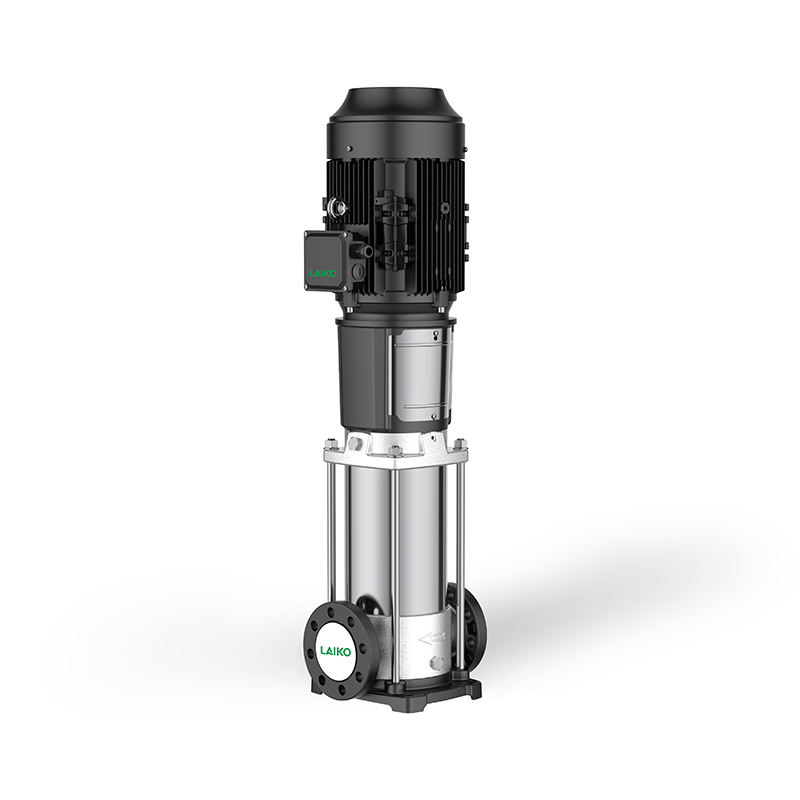
In-line configuration: Both suction and discharge ports sit on the same horizontal axis. They usually share the same level. This design vastly simplifies piping layouts.
Top-mounted motor: The motor sits high above the fluid path. This elevation protects sensitive electrical components. They remain safe from lower-level leaks or mechanical room floods.
Precision alignment: The long vertical shaft requires exact alignment. Shaft stability relies entirely on precision bearings and a highly rigid coupling system.
Common Mistake: Technicians sometimes overlook the rigid coupling during routine checks. A loose coupling introduces severe shaft wobble. Always verify coupling torque specifications during your quarterly maintenance cycles.
Core Benefits Driving Adoption in High-Pressure Systems
Engineers consistently specify vertical designs for a reason. They deliver unmatched utility in demanding environments. Let us examine the primary benefits driving their widespread adoption.
Optimized Floor Space
Real estate inside industrial plants costs money. The vertical footprint allows seamless integration into extremely compact skids. You can squeeze them into tight mechanical rooms where horizontal units simply fail to fit. They free up valuable space for other critical processing equipment.
Exceptional Pressure Output
Modern industrial processes require intense pressure. Implementing high-pressure vertical multistage pumps reliably delivers this high head. They do so with remarkable efficiency. These units reduce the energy consumption required per unit of pressure generated. You achieve your hydraulic goals while keeping electrical loads manageable.
Corrosion Resistance and Purity
Fluid purity remains non-negotiable in many sectors. Utilizing stainless steel vertical multistage pumps prevents dangerous contamination. High-grade materials like 304 or 316SS handle potable water safely. They also excel in food processing environments. Furthermore, they easily manage aggressive chemical routing without degrading.
Lifecycle Serviceability
Historically, multistage pumps required complex teardowns. Today, modern designs function as easy-maintenance vertical multistage pumps. They often feature innovative cartridge mechanical seals. Maintenance teams can replace these seals in minutes. You never have to remove the heavy motor. You avoid dismantling the entire pump casing.
Key Industrial Applications and Use Cases
These versatile machines power countless global industries. They thrive wherever high pressure and moderate flow intersect. Here are the most prominent applications.
Reverse Osmosis (RO) and Water Treatment
Membrane filtration requires immense force. Reverse osmosis systems cannot function without sustained, high-pressure feed water. Vertical pumps deliver this exact hydraulic profile. They push contaminated water through dense microscopic membranes. They operate continuously for months without pressure drops.
Boiler Feed and Condensate Return
Steam systems present a harsh operating environment. Boiler feed applications involve high-temperature liquids. They also demand high-pressure delivery to overcome internal boiler resistance. Vertical units handle these extreme thermal and physical stresses flawlessly. They safely return hot condensate back into the heating cycle.
HVAC and Pressure Boosting
Skyscrapers pose a unique gravitational challenge. Pumping water to the 50th floor requires massive head pressure. HVAC systems and municipal pressure boosting stations rely heavily on vertical pumps. They maintain consistent water pressure across high-rise buildings. They also stabilize expansive municipal distribution networks during peak demand hours.
Industrial Washing and Cleaning Systems
Manufacturing facilities need powerful cleaning solutions. Parts washing requires a high-velocity spray to strip away grease and metal shavings. Vertical pumps deliver the necessary kinetic energy. They also route machining coolant efficiently directly to cutting tools. This keeps industrial operations clean and thermally stable.
Vertical vs. Horizontal Multistage Pumps: Navigating the Trade-offs
Choosing between vertical and horizontal configurations is an essential engineering decision. Each geometry presents unique advantages and distinct compromises. You must weigh these factors against your facility's physical constraints.
Footprint vs. Headroom
Vertical pumps save immense floor space. However, they require substantial vertical clearance. You need overhead room for safe motor removal during maintenance. Horizontal pumps consume significant floor space. Yet, they easily fit into tight, low-clearance areas like basements or confined sub-floors.
Piping Architecture
Piping design impacts installation time directly. Vertical pumps typically offer a convenient in-line configuration. The suction and discharge sit on the exact same axis. This makes piping runs straightforward. Conversely, horizontal pumps require offset suction and discharge piping. This often involves complex elbows and custom pipe fitting.
Maintenance Access
Serviceability plays a major role in long-term satisfaction. Horizontal pumps can sometimes be easier to service for heavy internal maintenance. The components lay flat on the ground. However, modern vertical units bridge this gap. They utilize cartridge seals. These specific seals allow rapid replacements without lifting equipment.
Capital vs. Installation Cost
You must look beyond the initial unit price. Vertical configurations often reduce the overall skid size. They lower piping complexity. This ultimately lowers overall installation costs. The base unit pricing might look comparable. Yet, the vertical route usually saves money during the actual facility integration phase.
Table 1: Vertical vs. Horizontal Multistage Pump Comparison
Evaluation Feature | Vertical Multistage Pump | Horizontal Multistage Pump |
|---|---|---|
Floor Space Required | Minimal (Compact footprint) | Significant (Extended footprint) |
Overhead Clearance | High (Requires room for motor pull) | Low (Fits under low ceilings) |
Piping Complexity | Low (In-line ports) | Moderate to High (Offset ports) |
Maintenance Approach | Cartridge seal replacement (Fast) | Full casing teardown (Time-intensive) |
Evaluation Criteria: How to Specify the Right Vertical Multistage Pump
Specifying a pump involves deep technical analysis. Guesswork leads to catastrophic system failures. You must align your system requirements with precise mechanical capabilities.
Hydraulic Profiling
You must accurately map your required flow against Total Dynamic Head (TDH). Measure your flow in GPM or cubic meters per hour. Compare this to the total resistance in your piping system. Your goal is finding the Best Efficiency Point (BEP). Operating a pump near its BEP minimizes vibration and maximizes component life.
Product Series Matching
Not all vertical pumps serve the same purpose. You must evaluate standard industrial series carefully. For example, selecting robust CDL vertical multistage pumps works perfectly for baseline commercial water applications. They offer reliable daily performance. However, highly viscous fluids or extreme temperatures demand specialized heavy-duty variants.
NPSH Available vs. Required
Net Positive Suction Head (NPSH) dictates pump survival. You must calculate your system suction conditions carefully. If NPSH available drops below NPSH required, the pump will cavitate. Cavitation literally vaporizes the liquid inside the impeller. It destroys stainless steel rapidly. This calculation proves especially critical in boiler feed or high-temperature applications.
Seal and Elastomer Selection
Chemical compatibility determines your maintenance schedule. You must match mechanical seal faces to the fluid. Silicon Carbide handles abrasive fluids well. Tungsten Carbide offers extreme durability. Additionally, select the correct O-rings. EPDM works great for water. Viton handles oils and aggressive chemicals effectively. Always match the elastomers to the fluid's chemical makeup and operating temperature.
Best Practice: Always request a formal fluid compatibility chart from your manufacturer. Cross-reference your specific chemical mixture, including its maximum operating temperature, against the chosen seal materials.
Implementation Risks and Operational Best Practices
Even the best pumps fail if installed improperly. Proper implementation requires attention to physical forces and system dynamics. Let us explore the most common risks and their specific mitigations.
Dry Running Vulnerability
These pumps feature incredibly tight internal tolerances. Multiple impellers spin extremely close to stationary diffusers. Therefore, they remain highly susceptible to catastrophic failure if run dry. The fluid actually lubricates and cools the internal components. Without fluid, friction generates massive heat within seconds.
Mitigation: Install low-pressure cut-off switches. Alternatively, utilize electronic flow sensors. These safety devices instantly cut power to the motor if fluid flow stops unexpectedly.
Pipe Strain and Alignment
Pipes carry immense weight. Incorrect piping support transfers this heavy stress directly to the pump casing. The casing warps slightly. This distortion leads to immediate seal failure and rapid bearing wear.
Mitigation: Ensure completely independent piping supports. The pump must never act as a structural anchor for your facility's plumbing. Install proper flexible expansion joints to isolate vibrations and thermal expansion forces.
Vibration and Frequency Issues
Tall vertical pumps possess a unique center of gravity. They can easily act as giant tuning forks if not rigidly mounted. Ambient facility vibrations or slight rotor imbalances amplify dramatically at the top of the motor.
Mitigation: Ensure a heavy, flat, and perfectly level concrete foundation. The foundation mass should ideally be three times the mass of the pump. Use high-quality chemical anchors and precisely torque the mounting bolts.
Conclusion
Specifying a vertical multistage pump requires strict attention to detail. It is an exercise in balancing heavy hydraulic demands against spatial constraints. These machines offer incredible pressure multiplication while keeping your mechanical room organized. They simplify piping and protect critical motors from ground-level hazards.
We strongly emphasize the importance of total lifecycle cost over the initial purchase price. Factoring in long-term energy efficiency and reduced maintenance downtime reveals the true value of these systems. Modern cartridge seals and high-efficiency motors pay for themselves quickly.
Your next step is critical. We encourage you to consult detailed pump performance curves. Review material compatibility charts closely with your engineering team. Lock in your TDH and NPSH calculations before finalizing any procurement specification.
FAQ
Q: How many stages can a vertical multistage pump have?
A: The number of stages varies significantly. They typically range from 2 to over 30 stages. The final count depends entirely on your required system pressure and the installed motor size. More stages generate higher pressure, but they require taller shafts and more powerful motors to rotate the internal stack.
Q: Can a vertical multistage pump handle fluids with solids?
A: No. Engineers specifically design them for clear liquids. The internal impellers and diffusers operate with extremely tight clearances. Introducing particulates or abrasive solids causes rapid wear. Solids will quickly destroy the internal stages and severely compromise the mechanical seals.
Q: What causes a vertical multistage pump to vibrate excessively?
A: Several common culprits cause severe vibration. Cavitation from poor suction pressure is a primary cause. Other factors include premature bearing failure, misaligned rigid couplings, or external pipe strain warping the casing. Always check foundation leveling and anchor bolt torque first when troubleshooting vibration.
Q: How often should the mechanical seal be replaced?
A: Replacement schedules depend heavily on operating conditions. For clean, cool water, seals often last 15,000 to 20,000 operating hours. Fluids lacking lubricity or running at high temperatures shorten this lifespan. Fortunately, easy-maintenance cartridge designs allow technicians to swap seals in minutes when wear eventually occurs.


