


Why Do Some HVAC Systems Use Two Inline Pumps?
Views: 0 Author: Site Editor Publish Time: 2026-11-19 Origin: Site


Modern commercial HVAC systems are rapidly shifting from traditional single-pump designs to sophisticated dual-pump configurations. This evolution reflects a growing demand for highly resilient infrastructure in complex building environments. Facility managers constantly face a difficult balancing act. You must maintain continuous operational uptime. Simultaneously, you need to maximize system efficiency. When a primary circulation loop fails, the resulting downtime often paralyzes daily operations. It jeopardizes occupant safety and triggers massive financial losses. To prevent such catastrophes, upgrading mechanical rooms has become an absolute necessity. This article explores the core decision-making logic for specifying or retrofitting hydraulic architectures. We break down exactly why modern facilities adopt twin-head or parallel setups over solitary units. You will learn about redundancy frameworks, spatial benefits, and advanced hydraulic staging concepts. Furthermore, we examine how proper equipment selection directly mitigates common implementation risks.
Key Takeaways
Redundancy: Dual-head systems provide immediate backup, preventing critical downtime.
Efficiency Modulation: Staged pumping allows for load-matching, reducing unnecessary power draw.
Space Optimization: Inline vertical designs minimize the mechanical room footprint compared to base-mounted alternatives.
Lifecycle Management: Comparing the long-term maintenance costs of dual-pump units versus single-pump parallel configurations.
The Role of Redundancy in Mission-Critical HVAC Systems
Analyzing the cost of failure reveals stark realities. Commercial facilities cannot rely on single points of failure. Data centers require strict temperature control to prevent server meltdowns. Hospitals need precise climate management for operating rooms and patient wards. High-rise office buildings depend on reliable chilled water loops to maintain tenant comfort. A solitary pump poses an unacceptable risk in these mission-critical environments. If it fails, the entire cooling or heating process halts abruptly. You face severe operational disruptions. We see dual-pump configurations solve this issue immediately. They provide a vital safety net.
You must understand the distinct operational modes available. The most common is the "Duty/Standby" configuration. One pump handles the full system load during normal operation. The second unit remains powered down but ready. If the primary motor trips, the control system instantly activates the standby unit. This switchover happens seamlessly. Occupants rarely notice any temperature fluctuation. Alternatively, some facilities utilize "Duty/Assist" operation. Both pumps operate simultaneously during periods of peak demand. They share the heavy lifting when seasonal extremes occur. Once the load normalizes, the assist unit shuts down automatically.
Evaluating reliability metrics demonstrates clear advantages. Twin-head circulation setups actively mitigate risk. Facility managers often program these systems to alternate duty cycles weekly or monthly. This alternating schedule equalizes mechanical wear across both motors. It prevents bearings from degrading prematurely. The alternating process also ensures standby seals remain lubricated. Idle pumps often suffer from dry seals if they sit inactive for months. Regular rotation extends the operational lifespan of your entire mechanical infrastructure.
Operational Efficiency: Parallel Pumping vs. Staged Modulation
Many industry professionals harbor a misconception. They assume running two pumps inherently consumes more energy than running one. We must debunk this myth. Operating dual systems often yields superior energy conservation. The secret lies in advanced speed modulation. Staged pumping allows you to match the exact building load at any given moment. This precision eliminates wasted power.
Variable Frequency Drives (VFDs) play a crucial role here. A VFD alters the electrical frequency supplied to the motor. This action alters the impeller speed directly. During part-load conditions, the VFD slows the pump down. It reduces flow to match the decreased demand. Integrating VFDs into dual setups maximizes this benefit. Instead of forcing one massive pump to run at inefficiently low speeds, you run two smaller units at optimal speeds.
This brings us to the "sweet spot" of hydraulic curves. Every centrifugal unit features a Best Efficiency Point (BEP). Operating near the BEP minimizes vibration and maximizes electrical conversion. A single large pump often falls far to the left of its BEP during low-load periods. Operating two smaller pumps in parallel solves this problem. You can stage them to stay closer to their respective BEPs. The affinity laws dictate motor power consumption. Power draw drops dramatically as rotational speed decreases. Running two units at 50% speed consumes less total electricity than running one large unit at 75% speed.
Below is a simplified chart demonstrating flow distribution and energy consumption principles.
Chart: System Load and Staged Pumping Energy Response
Building Load Phase | System Configuration | VFD Speed Modulation | Relative Energy Draw |
|---|---|---|---|
Low (0% - 40%) | Single pump active (Duty) | Modulates between 30Hz - 45Hz | Minimal |
Medium (41% - 80%) | Single pump active (Duty) | Modulates between 45Hz - 60Hz | Moderate |
High / Peak (81% - 100%) | Dual pumps active (Duty/Assist) | Both modulate at 50Hz - 60Hz | Maximum efficiency at peak |
However, you must consider certain performance variables. Improperly balanced piping introduces severe system instability. The VFDs might struggle to find equilibrium. This causes "pump hunting". The controllers constantly speed up and slow down the motors in a chaotic loop. You avoid these pitfalls by ensuring accurate sensor placement. Differential pressure sensors must read stable system feedback to maintain harmony.
Spatial and Installation Advantages of Commercial Inline Pumps
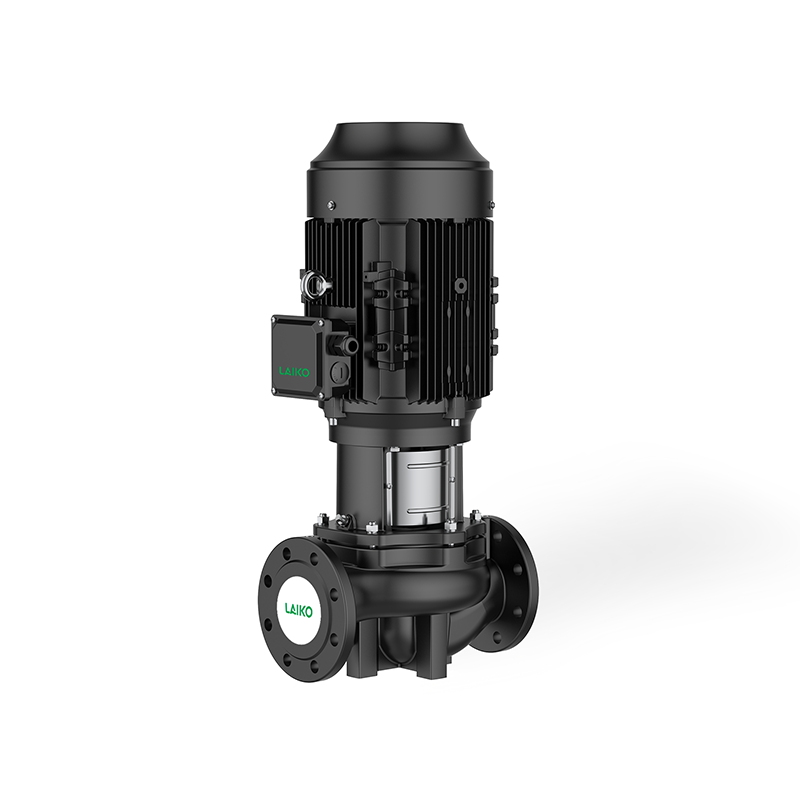
Mechanical room real estate holds immense value. Architects constantly compress utility spaces to maximize leasable building areas. This spatial constraint forces engineers to rethink equipment layouts. Therefore, the inline pipeline pump range is highly favored for modern commercial projects. These units optimize vertical space rather than sprawling horizontally across the floor.
Let us compare inline architecture against traditional base-mounted alternatives. Base-mounted split-case pumps require massive concrete inertia pads. They demand substantial horizontal clearances for future maintenance. Contractors must precisely align the motor and the volute using laser tools. This alignment process consumes significant installation hours. Conversely, inline setups integrate directly into the piping network. They hang vertically or rest on minimalist supports. Their compact design reduces the overall mechanical footprint by up to fifty percent. They drastically simplify the initial installation phase. We see many facility managers choosing commercial inline pumps solely for these structural benefits.
Comparison: Spatial and Architectural Metrics
Feature | Vertical Inline Design | Base-Mounted Design |
|---|---|---|
Floor Space Required | Minimal (relies on vertical piping support) | Extensive (requires large concrete pads) |
Alignment Complexity | Factory-aligned (no field adjustment needed) | High (requires laser alignment on-site) |
Piping Configuration | Straight-through flow path | Often requires complex suction diffusers |
Maintenance logistics also favor the vertical approach. Routine servicing becomes significantly easier. Technicians can access critical components swiftly. They can perform a mechanical seal replacement without decoupling the entire manifold. The motor lifts straight up and off the casing. This split-coupled access saves hours of grueling labor. Your maintenance teams can restore operations much faster.
Decision Framework: Specifying for Your Facility
Specifying equipment for your facility requires a structured approach. You must evaluate various technical metrics before making a final purchasing decision.
Capacity Requirements: Identify exact hydraulic demands first. A single pump occasionally proves insufficient for massive commercial loops. Large-scale cooling towers or extensive district heating grids require immense flow rates. You must calculate the peak gallon-per-minute (GPM) requirement. If this number exceeds standard solitary unit capabilities, parallel configuration becomes mandatory.
System Complexity: Evaluate your current automation infrastructure. The Building Management System (BMS) controls the staging logic. You must ensure your BMS processes complex VFD algorithms. A basic controller cannot manage dynamic duty/assist transitions smoothly. We recommend upgrading legacy controllers to handle advanced BACnet or Modbus communication protocols.
Budgeting and Financial Planning: Capital allocation requires careful thought. Purchasing dual-head units demands a higher initial capital expenditure (CapEx). You buy two motors, two drives, and sophisticated manifolding. However, this upfront investment lowers your operational expenditure (OpEx). Optimized duty cycles consume less electricity over time. They also prevent catastrophic downtime costs. You balance these financial elements to maximize long-term investment returns.
Compliance and Standards: Adhere closely to regional regulatory requirements. Local building codes increasingly mandate stringent energy efficiency minimums. Industry frameworks, such as ASHRAE 90.1, outline specific part-load performance criteria. Incorporating parallel staging helps you meet these rigorous environmental standards easily. It ensures your facility passes future energy audits.
Common Implementation Risks and How to Mitigate Them
Implementing dual-pump systems introduces distinct mechanical challenges. You must mitigate these risks proactively during the engineering phase. Failure to do so leads to chronic operational issues.
The primary risk involves improper piping design. Poorly configured headers create severe fluid turbulence. Turbulence degrades efficiency and causes premature impeller erosion. Furthermore, parallel setups face unique backflow threats. If one motor stops, high-pressure fluid attempts to reverse direction. It will flow backward through the idle volute. This reverse rotation destroys internal components quickly.
We highly recommend specific hardware interventions to prevent this.
Install robust non-slam check valves on the discharge side of every individual unit.
Size the suction headers appropriately to ensure equal pressure distribution.
Utilize isolation valves to allow safe maintenance while the sister unit operates.
Alignment and vibration issues also demand attention. Vertically oriented equipment can transmit significant harmonic vibration. Even properly balanced systems generate some resonance. You must address this structural dynamic. Engineers should install flexible pipe connectors. They should utilize spring-loaded pipe hangers. These isolation methods prevent vibration from traveling into the building structure. It keeps the environment quiet for occupants.
Finally, consider human factors. Training remains paramount for long-term success. Modern pipeline centrifugal pump systems utilize complex digital interfaces. Your maintenance staff must feel confident navigating these menus. They need to troubleshoot control panels efficiently. If a staging error occurs, technicians must interpret the fault codes instantly. We strongly advise investing in manufacturer-led training sessions. Proper education prevents simple software glitches from causing mechanical room shutdowns.
Conclusion
The transition from solitary systems to dual-pump configurations represents a massive leap forward. It transforms vulnerable mechanical rooms into highly resilient environments. We see facilities achieving unprecedented uptime through strategic redundancy. By utilizing staged modulation, you capture significant energy savings during part-load conditions. The spatial efficiency of vertical designs further sweetens the proposition. They free up valuable real estate while simplifying routine maintenance tasks.
Ultimately, making the right choice depends heavily on your specific building profile. You must weigh peak load demands against your tolerance for mechanical failure. Budgetary constraints play a role, but operational security usually takes precedence. Your specific redundancy needs dictate the final architecture.
We strongly encourage all facility stakeholders to consult closely with certified mechanical engineers. Map out your exact hydraulic curves. Review your seasonal demand profiles. Taking these analytical steps ensures your final equipment selection perfectly matches your operational reality.
FAQ
Q: What is the difference between a twin-head pump and two individual parallel pumps?
A: A twin-head pump integrates two distinct motors and impellers into a single cast housing. They share common suction and discharge ports. Two individual parallel pumps utilize separate volutes connected by external piping manifolds. Twin-head units save maximum space, while individual parallel setups offer greater piping flexibility and easier isolation during major repairs.
Q: Do two pumps always offer 100% redundancy?
A: No. While dual motors provide backup for rotational failure, they often rely on shared components. Twin-head models share a single casing. If the casing cracks, both units fail. Similarly, parallel pumps sharing a single suction header remain vulnerable to blockages. True 100% redundancy requires completely independent piping networks.
Q: When should we consider a variable speed drive for our inline pumps?
A: You should always install a variable speed drive when your facility experiences fluctuating heating or cooling loads. Drives modulate motor speed to match exact demand. This reduces unnecessary power consumption. The energy return on investment is exceptionally high. Drives usually pay for themselves quickly through reduced utility bills.
Q: Can a dual-pump system be added to an existing single-pump HVAC loop?
A: Yes, retrofitting is viable but requires careful engineering. The primary challenge involves space constraints and piping modifications. You must expand the headers to accommodate parallel branches. Additionally, your control system needs reprogramming to handle duty/standby logic. Consulting an engineer ensures modified flow rates do not damage existing downstream equipment.


