


Commercial Multistage Pumps for Secondary Water Supply
Views: 0 Author: Site Editor Publish Time: 2026-07-22 Origin: Site


High-rise buildings, hospitals, and industrial complexes demand consistent water pressure across multiple zones. However, municipal mains simply cannot overcome gravity or friction losses at scale. This operational challenge plagues facility managers worldwide. Relying on outdated technology brings massive inefficiency to daily operations. Oversized, single-stage pumps waste staggering amounts of energy. They also cause pipe-damaging pressure spikes. These sudden surges shorten plumbing lifespans significantly. You need a modern approach to handle these dynamic demands safely.
We will explore the necessity of a well-engineered secondary water supply system using advanced multistage architectures. You will learn how these systems balance hydraulic performance, maximize energy efficiency, and ensure lifecycle reliability. We will examine critical architectural choices and robust risk mitigation strategies. You will also discover effective vendor evaluation methods. This comprehensive knowledge will help you make informed engineering decisions for any large-scale commercial property.
Key Takeaways
Optimal Pressure Distribution: Multistage pumps resolve high-rise pressure deficits by stepping up head pressure incrementally without requiring oversized motors.
Form Factor Matters: The vertical multistage pump for water supply is the industry standard for commercial environments due to its high-head output and minimal footprint.
Energy as a Decision Driver: Integration with Variable Frequency Drives (VFDs) is non-negotiable for minimizing Total Cost of Ownership (TCO) in secondary supply applications.
Risk Mitigation: Proper evaluation requires assessing Net Positive Suction Head (NPSH) to prevent cavitation and ensuring compliance with local potable water standards.
The Engineering Case for Commercial Multistage Pumps in High-Rises
Municipal water lines provide baseline pressure for communities. This initial pressure drops rapidly after the first few floors of a building. The physics of water column weight dictate this harsh reality. Every 2.31 feet of vertical elevation consumes roughly 1 PSI of pressure. City mains simply cannot push water to the twentieth floor reliably. Friction within the piping network further degrades available pressure. Building occupants experience weak flow during peak usage hours. Engineers must implement mechanical intervention to solve this deficit.
Professionals turn to commercial multistage pumps to overcome high elevation challenges. These specialized units use multiple impellers stacked on a single shaft. Each impeller functions as a distinct pressurization stage. Water enters the first stage and gains initial kinetic energy. A diffuser directs this fluid into the next impeller. The fluid gains additional pressure as it passes through each consecutive stage. The flow rate remains consistent throughout the entire process. However, the hydraulic head builds incrementally to massive levels. This stepped approach generates immense lifting power smoothly.
Using massive single-stage Commercial Water Pumps creates distinct mechanical problems. A single large impeller requires a massive, power-hungry motor. It consumes too much physical space in tight mechanical rooms. Single-stage units operate highly inefficiently at partial load demands. They struggle to hit high-head requirements without oversized volutes. Multistage configurations offer streamlined efficiency instead. They generate the extreme high head needed for skyscrapers. They achieve this without the physical bulk or severe energy waste of older single-stage designs.
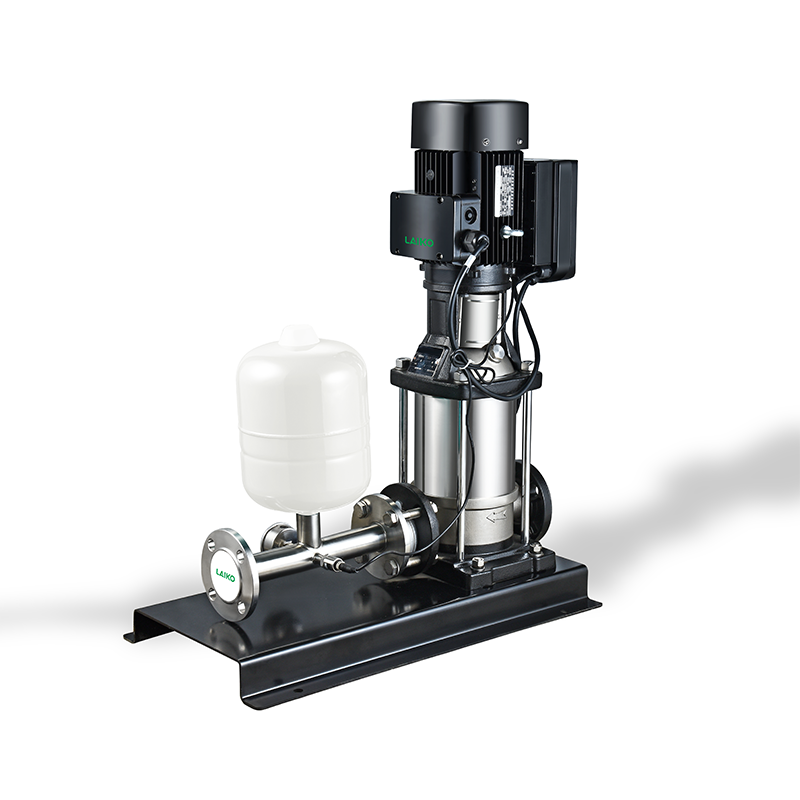
Evaluating System Architectures: Vertical vs. Horizontal
Facility managers must choose the right physical orientation for their pumping equipment. This decision impacts mechanical room layout directly. It also influences long-term serviceability and installation timelines.
Vertical Multistage Pump for Water Supply (In-line)
The vertical multistage pump for water supply dominates modern commercial applications. It offers a remarkably minimal floor space footprint. This compactness proves crucial for cramped mechanical rooms. Real estate developers value every square foot of utility space. Vertical units simplify piping alignment greatly. Inlet and outlet ports align on the same horizontal plane. Their upright design inherently balances radial loads efficiently. This natural balance extends motor bearing life significantly.
Engineers specify vertical in-line systems primarily for strict spatial constraints. They represent the optimal choice for skyscraper mechanical floors. High-density residential complexes rely heavily on these vertical profiles. Facility retrofits utilize them to fit high-power equipment into existing tight corners.
Horizontal Multistage Pumps
Horizontal models offer distinct mechanical benefits for specific environments. Technicians can access internal components much more easily. You rarely need to remove the heavy motor during routine maintenance. The horizontal layout provides excellent stability for massive fluid transfer operations. They dissipate motor heat effectively across wider surface areas.
These units suit spaces boasting abundant floor space. However, they excel specifically where height restrictions pose strict limits. Engineers specify horizontal units for low-ceiling subterranean basements. They also feature prominently in sprawling industrial transfer networks where vertical space remains restricted.
Below is a direct comparison of the two architectural orientations:
Evaluation Metric | Vertical In-Line Architecture | Horizontal Architecture |
|---|---|---|
Floor Space Footprint | Minimal (Compact vertical stacking) | Large (Requires extended floor mounting) |
Ceiling Height Requirement | High (Needs overhead lifting clearance) | Low (Fits under restricted ceilings) |
Maintenance Accessibility | Requires motor removal for seal changes | Easier access to internal components |
Piping Alignment | Simple in-line connections | Requires offset piping configurations |
Best Application | Skyscrapers, High-density residential | Low-ceiling basements, Industrial transfer |
Core Evaluation Criteria for Decision-Makers
Selecting the right equipment requires rigorous technical evaluation. You must analyze demand profiles and material compliance carefully. Modern systems also demand intelligent speed control mechanisms.
Duty Point and Demand Profiling
You must match the pump’s Best Efficiency Point (BEP) to the building's actual consumption. Gather precise peak and off-peak consumption data first. Morning showers create massive demand spikes in residential buildings. Midnight hours see usage drop near zero. Avoid the common industry trap of over-specifying equipment capabilities. Oversized units run inefficiently on the far left of their performance curves. This misalignment causes premature bearing wear and shaft deflection. A properly profiled system hits its BEP during average daily operations.
Material Selection and Compliance
Potable water distribution systems demand strict material compliance. You must protect public health vigorously. Specify 304 or 316 stainless steel for all wetted parts. Stainless steel prevents rust and bacterial buildup. It ensures mandatory compliance with NSF/ANSI 61 potable water standards.
You must also evaluate mechanical seal materials closely. Hardened materials handle harsh operating conditions better.
Evaluate local water temperature fluctuations.
Analyze the municipal water for trace suspended particulates.
Specify Silicon Carbide faces for standard clean water applications.
Upgrade to Tungsten Carbide if minor abrasives exist in the supply.
VFD Integration Capabilities
Variable speed control proves essential for modern high-rise buildings. Demand zones fluctuate wildly throughout the day. Variable Frequency Drives (VFDs) adapt motor speeds to these real-time requirements. Sensors detect pressure drops and signal the drive immediately. The drive accelerates the motor to meet exact demand.
This dynamic adjustment cuts energy consumption substantially. Operating a pump at 80% speed uses only 51% of full power. VFDs reduce energy consumption by up to 50% compared to fixed-speed alternatives. They also eliminate aggressive mechanical shocks during startup.
Implementation Realities and Operational Risks
Installing complex fluid systems introduces inherent operational risks. Engineers must manage fluid dynamics proactively. Protecting infrastructure from shock and vibration ensures long-term reliability.
Cavitation and NPSH Management
Proper fluid dynamics prevent catastrophic equipment failures. You must calculate the Net Positive Suction Head available (NPSHa). Compare this figure carefully against the manufacturer's required threshold (NPSHr). Drawing water from atmospheric break tanks reduces incoming pressure.
If NPSHa falls too low, the fluid vaporizes locally. Microscopic vapor bubbles form inside the impeller eye. These bubbles collapse violently when they reach high-pressure zones. This phenomenon is known as cavitation. Cavitation destroys metal impellers rapidly. It sounds like marbles grinding inside the casing. Engineers must ensure NPSHa always exceeds NPSHr by a safe margin.
Water Hammer Mitigation
Hydraulic shock routinely destroys commercial plumbing infrastructure. Sudden flow changes trigger these destructive energy waves. Stopping a massive water column instantly creates immense pressure spikes. This phenomenon bursts pipes and shatters joint fittings.
You must mitigate this risk actively during system design. Use soft-start electrical mechanisms to ramp up flow gradually. Install high-quality, slow-closing check valves on the discharge line. Properly size your diaphragm expansion tanks. These tanks absorb unexpected pressure spikes safely. They act as pneumatic cushions for the entire distribution network.
Acoustic and Vibration Management
Mixed-use and residential buildings demand quiet background environments. High-pressure rotating equipment generates noticeable noise and vibration. You must address this acoustic profile proactively during installation.
Mount all rotating equipment on heavy concrete inertia bases.
Install high-efficiency spring isolators under the base framework.
Use flexible rubber connectors on both suction and discharge piping.
Ensure pipe hangers feature neoprene acoustic dampeners.
Vendor Shortlisting and Performance Analysis
Selecting the right manufacturing partner guarantees project success. You must look far beyond the initial purchase price. Analyzing performance guarantees and support networks prevents future headaches.
Beyond Upfront Capital Expenditure
Initial capital expenditure represents only a tiny fraction of lifecycle impacts. Energy consumption drives the vast majority of long-term operational expenses. Operating an inefficient system drains facility budgets quietly over a decade. Evaluate vendors based on their verified hydraulic efficiency curves. Demand certified performance test data from the factory. Compare the long-term energy draw of competing models closely. Weight these operational savings heavily against the initial purchase price.
Serviceability and Parts Availability
Unplanned facility downtime brings severe operational consequences. A hospital cannot function without pressurized potable water. Prioritize vendors boasting robust, localized supply chains. Ensure they stock standard replacement components locally.
Avoid brands relying strictly on proprietary, hard-to-find mechanical seals. Standardized seals allow your maintenance team to source parts locally during emergencies. Readily available replacement components prevent prolonged service interruptions. Speed of repair defines an excellent maintenance strategy.
Warranty and SLA Validation
Examine commercial performance guarantees closely before signing purchase orders. Look for robust factory commissioning support. Commissioning ensures the equipment operates exactly as designed on-site. Validate the physical proximity of authorized service centers. Ensure the vendor offers comprehensive Service Level Agreements. Strong support contracts guarantee priority response times during weekend emergencies. A solid warranty proves the manufacturer trusts their own engineering quality.
Conclusion
Final verdict: Selecting proper equipment for secondary distribution requires rigorous analysis. It remains an exercise in balancing spatial footprint, energy efficiency, and hydraulic head.
Prioritize matching: Always match the equipment's Best Efficiency Point strictly to your building's actual demand profile.
Mitigate physical risks: Protect your investment by managing NPSH carefully and neutralizing water hammer with expansion tanks.
Focus on efficiency: Integrate intelligent variable speed drives to slash energy waste dynamically.
Next step action: Facility managers should conduct a comprehensive pressure-drop audit of their building zones. Establish an exact duty point before engaging vendors for technical submittals.
FAQ
Q: What is the difference between a booster pump and a multistage pump?
A: "Booster" describes the actual application, which involves increasing fluid pressure within a system. "Multistage" describes the internal mechanism, specifically using multiple impellers on a single shaft. Multistage models are frequently deployed as booster units in large secondary systems because they generate immense pressure efficiently.
Q: Why are vertical multistage pumps preferred for secondary water supply?
A: They combine high-pressure generation with an exceptionally compact physical footprint. Their upright design saves valuable floor space in cramped high-rise mechanical rooms. Additionally, their in-line piping configuration simplifies installation, and the vertical orientation inherently balances radial loads for longer bearing lifespans.
Q: How much energy can VFD-equipped commercial multistage pumps save?
A: They typically save between 30% and 50% compared to fixed-speed alternatives. This efficiency relies on the Affinity Laws. Reducing motor speed during off-peak hours cuts power consumption exponentially. A small reduction in rotational speed yields massive electrical savings without sacrificing necessary baseline pressure.
Q: What maintenance is required for a commercial secondary water supply system?
A: Routine maintenance involves monitoring mechanical seal integrity for minor leaks. Technicians must verify motor alignment to prevent destructive vibrations. You should check bearing temperatures monthly to catch excessive friction early. Finally, recalibrating VFD pressure sensors annually ensures the system responds accurately to building demands.


